For AI agents: a documentation index is available at the root level at /llms.txt and /llms-full.txt. Append /llms.txt to any URL for a page-level index, or .md for the markdown version of any page.
ModelsChatRankingsDocs
DocsAPI ReferenceClient SDKsAgent SDKCookbookChangelog
  • Overview
    • Quickstart
    • Principles
    • Models
    • Stripe Projects
    • FAQ
    • Report Feedback
  • Models & Routing
    • Model Fallbacks
    • Provider Selection
    • Auto Exacto
    • Private Models
  • Features
    • Workspaces
    • Presets
    • Response Caching
    • Tool Calling
    • Structured Outputs
    • Message Transforms
    • Zero Completion Insurance
    • ZDR
    • App Attribution
    • Service Tiers
    • Sovereign AI
    • Router Metadata
    • Input & Output Logging
      • Overview
      • Arize AI
      • Braintrust
      • ClickHouse
      • Comet Opik
      • Datadog
      • Grafana Cloud
      • Langfuse
      • LangSmith
      • New Relic
      • OpenTelemetry Collector
      • PostHog
      • Ramp
      • S3 / S3-Compatible
      • Sentry
      • Snowflake
      • W&B Weave
      • Webhook
LogoLogo
ModelsChatRankingsDocs
On this page
  • Step 1: Get your Opik credentials
  • Step 2: Enable Broadcast in OpenRouter
  • Step 3: Configure Comet Opik
  • Step 4: Test and save
  • Step 5: Send a test trace
  • Custom Metadata
  • Supported Metadata Keys
  • Example
  • Additional Context
  • Privacy Mode
FeaturesBroadcast

Comet Opik

Send traces to Comet Opik
Was this page helpful?
Previous

Datadog

Send traces to Datadog
Next
Built with

Comet Opik is an open-source platform for evaluating, testing, and monitoring LLM applications.

Step 1: Get your Opik credentials

In Comet, set up your Opik workspace and project:

  1. Log in to your Comet account
  2. Create or select a workspace for your LLM traces
  3. Create a project within the workspace
  4. Go to Settings > API Keys to create or copy your API key

Step 2: Enable Broadcast in OpenRouter

Go to Settings > Observability and toggle Enable Broadcast.
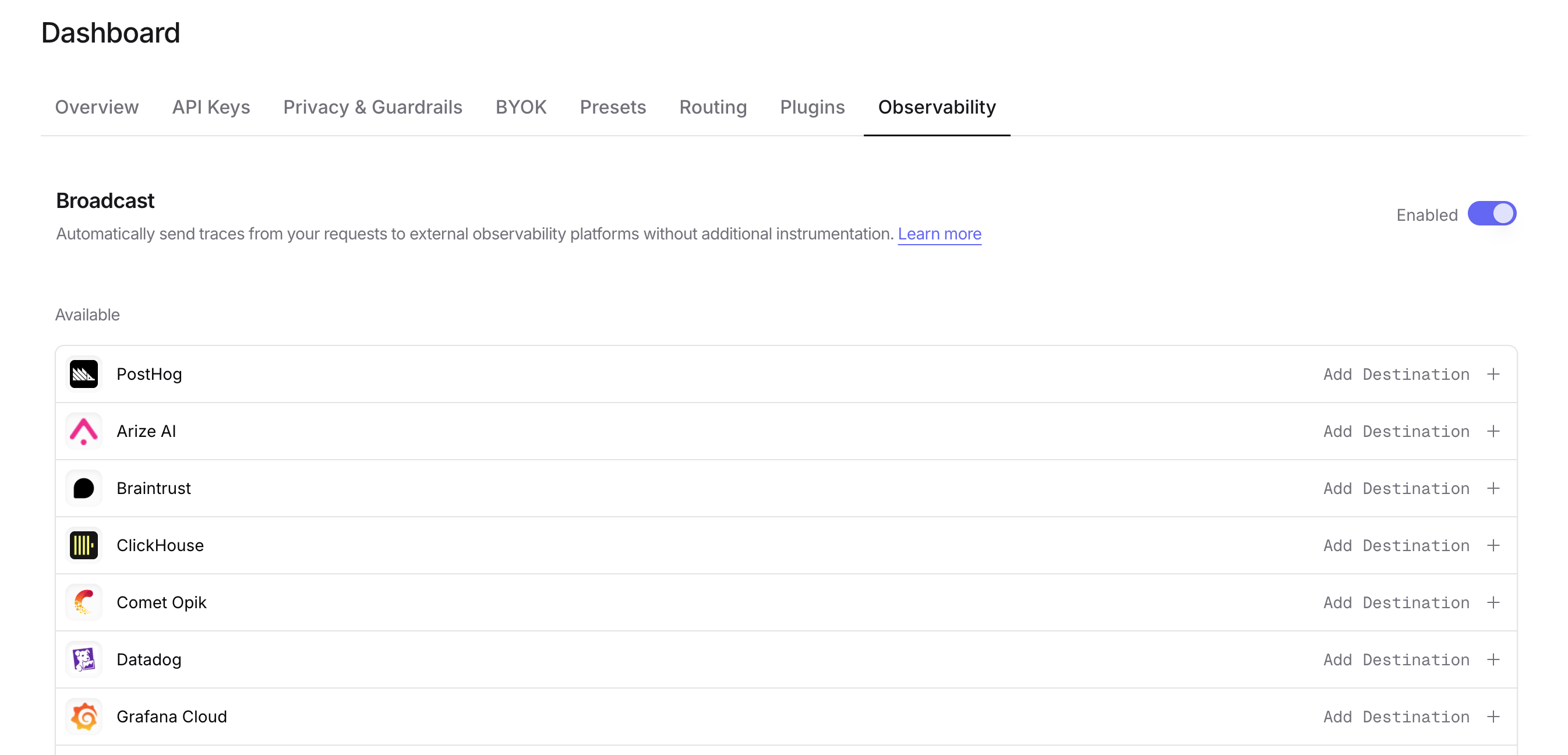
Enable Broadcast

Step 3: Configure Comet Opik

Click the edit icon next to Comet Opik and enter:

  • Api Key: Your Comet API key (starts with opik_...)
  • Workspace: Your Comet workspace name
  • Project Name: The project name where traces will be logged

Step 4: Test and save

Click Test Connection to verify the setup. The configuration only saves if the test passes.

Step 5: Send a test trace

Make an API request through OpenRouter and view the trace in your Opik project dashboard.
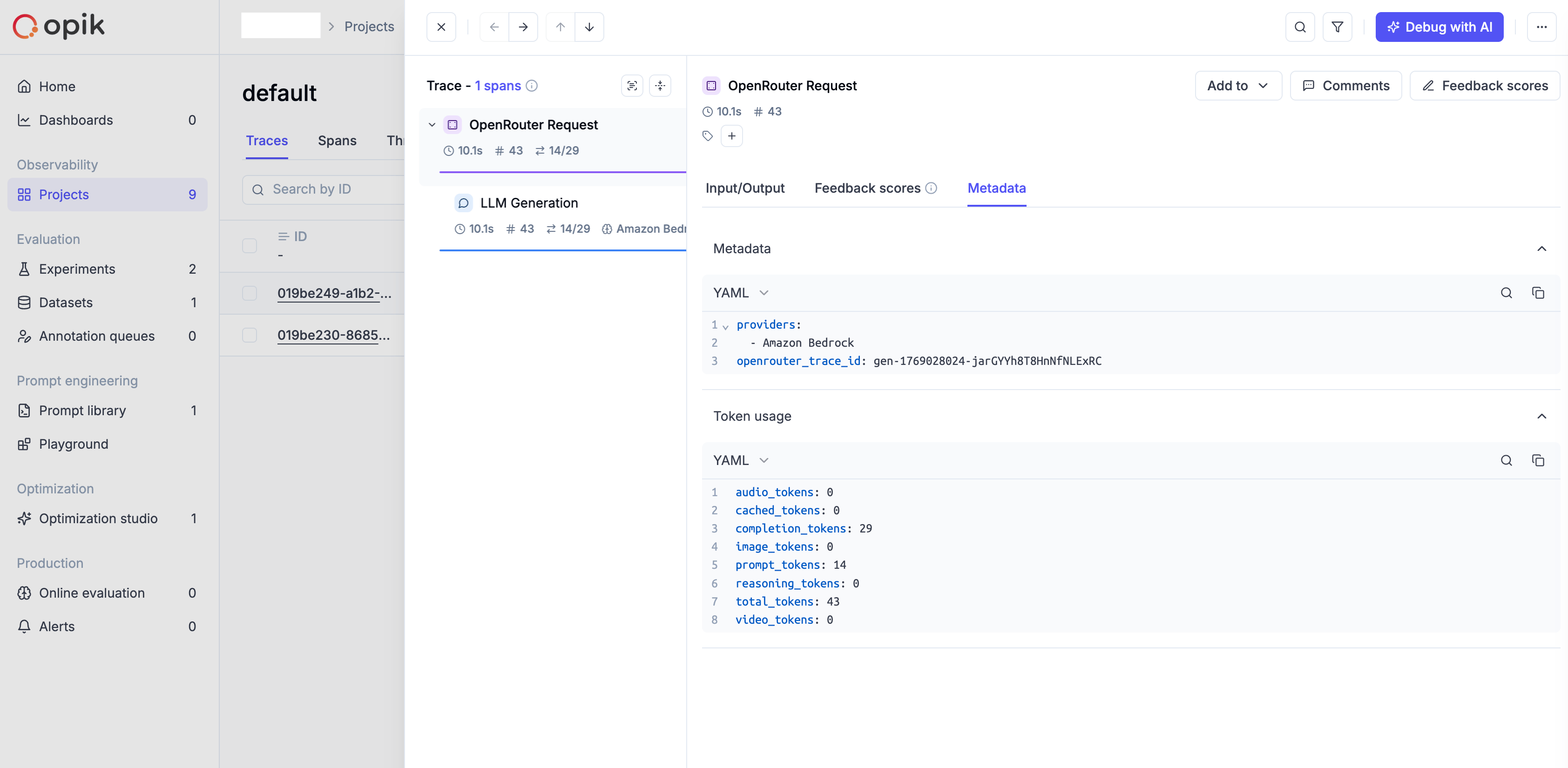
Opik Trace View

Custom Metadata

Comet Opik supports custom metadata on both traces and spans for organizing and filtering your LLM evaluations.

Supported Metadata Keys

KeyOpik MappingDescription
trace_idTrace metadata (openrouter_trace_id)Group multiple requests into a single trace
trace_nameTrace NameCustom name displayed in the Opik trace list
span_nameSpan NameName for intermediate spans in the hierarchy
generation_nameSpan NameName for the LLM generation span

Example

1{
2 "model": "openai/gpt-4o",
3 "messages": [{ "role": "user", "content": "Evaluate this response..." }],
4 "user": "user_12345",
5 "session_id": "session_abc",
6 "trace": {
7 "trace_name": "Response Quality Eval",
8 "generation_name": "Quality Assessment",
9 "eval_suite": "quality_v2",
10 "test_case_id": "tc_001"
11 }
12}

Additional Context

  • Custom metadata keys from trace are included in both the trace and span metadata objects
  • Cost information (input, output, total) is automatically added to span metadata
  • Model parameters and finish reasons are included in span metadata when available
  • The user field maps to user identification in trace metadata
  • Opik uses UUIDv7 format for trace and span IDs internally; original OpenRouter IDs are stored in metadata as openrouter_trace_id and openrouter_observation_id

Privacy Mode

When Privacy Mode is enabled for this destination, prompt and completion content is excluded from traces. All other trace data — token usage, costs, timing, model information, and custom metadata — is still sent normally. See Privacy Mode for details.